How easy it is to fake a music copyright claim

A music copyright claim with no owner
The claimant’s email bounced. Didn’t exist. Neither side answered a single message. That’s when an already strange Apple Music copyright situation got worse.
I was looking at it from a music distributor’s chair. The person filing the claim had the exact same name as the person who supposedly uploaded the unauthorised track. Same first name. Same record label. Same track title. On paper, a perfect match.
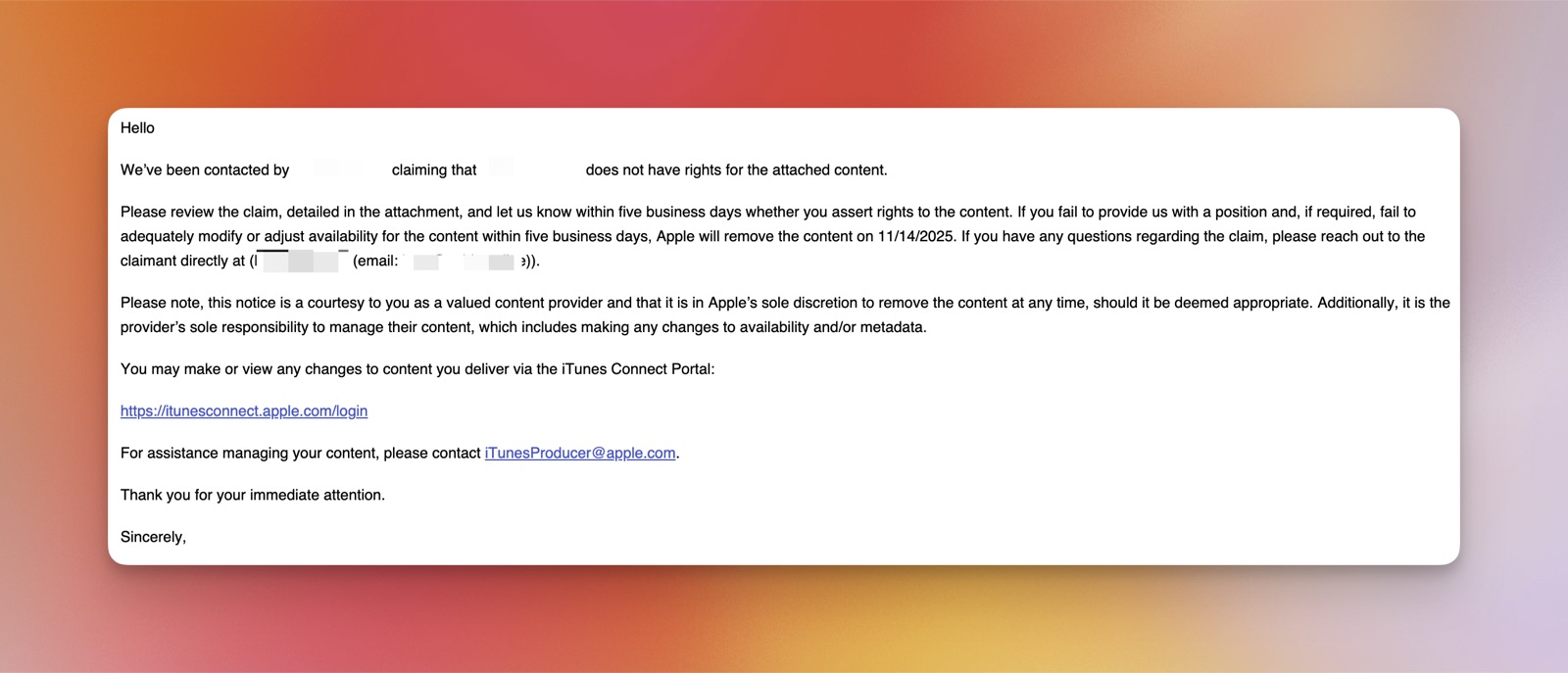
I dug into the claimant. One-page website. No social presence. Some artist management company, apparently.
If both people go silent, or don’t exist, you have to ask the obvious question: does either party actually own this music?
The file had no fingerprint
The WAV didn’t help. No ACR hit. No fingerprint. I even tried Shazam on my phone. The system shrugged. When the tech doesn’t recognise the audio and the humans disappear, you’re left with a mess.
Why stems won’t prove ownership
So how do you prove ownership?
Asking for stems on every release is a fantasy. Stems can be recreated or approximated with AI. No distributor can sit and check them by ear (imagine three minutes of snare). Make that the standard and the pipeline stops, or the cost jumps.
Anyone can trigger a takedown
The deeper problem is how little it takes to file the claim. Anyone can email Apple Music or another DSP, point at a catalogue, say “they don’t own this,” and start a takedown review. Apple forwards it. The distributor flags it. The music comes down. The evidence was an email.
Platforms take the cautious route: remove first, verify later. Fine when the proof is in front of you. Chaos when it isn’t.
We need a verification layer that checks ownership before the takedown, not a full forensic audit, just something stronger than “a matching name sent a message.”
Right now it’s too easy to weaponise music copyright, and too hard to defend a legitimate catalogue.
The industry won’t scale until that gets fixed.