How fake streams steal music streaming royalties

A 35,000 fake stream case
A fake stream case landed on my desk recently. Well, via Slack. It’s 2026. Spotify had flagged 35,000 artificial streams. The artist’s team swears they had nothing to do with it. Maybe they bought a dodgy playlisting service without knowing what they were paying for. Maybe they knew exactly. I can’t prove either version. I can’t see the transaction. I can’t see who bought the streams. All I can do is take their word, watch the account, and know that if it happens again the whole distribution feed is at risk.
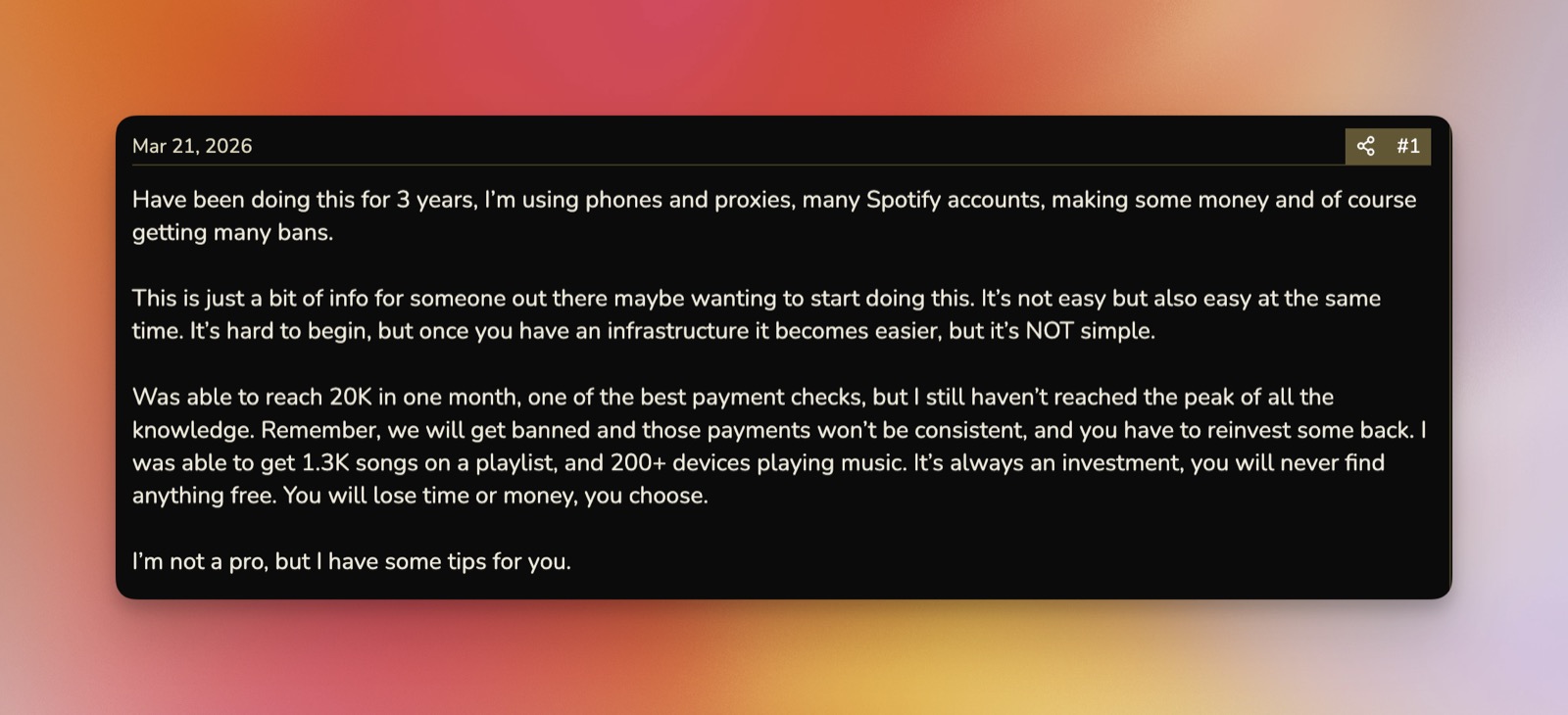
That’s enforcement from the distributor side. Incomplete information, money already gone.
How the pro-rata pool makes fake streams pay
The reason the money is already gone is the pool. Every month Spotify dumps what it made into one pot, skims about 30%, and splits the rest by share of total streams. Your tracks were 0.01% of plays? You get 0.01% of the money. Simple on paper. That simplicity is what makes fake streams so easy to cash.
Pro-rata means every fake stream is a withdrawal from every legitimate artist’s royalties. A bot farm looping a track ten thousand times is taking from people who wrote real songs and built real audiences. The independent artist who spent months on an album and scraped together a few hundred quid just had their cut diluted by someone who didn’t write a note.
AI mass uploads changed the game
The scale has shifted. A real artist might spend a year-plus on 100 tracks. Someone with generative AI can knock out 100 in an afternoon. I see accounts pushing hundreds of AI-generated tracks a week. I’m not saying everyone using Gen-AI is a bad guy. A lot of these catalogues exist because each track is another node in a royalty collection network. Spread the fake plays, keep the numbers modest per track, ramp slowly, and you are much harder to catch than the old trick of hammering one song with millions of bot plays.
That evolution worries me. Michael Smith made headlines for siphoning over $8 million with AI tracks across Spotify, Amazon Music, and Apple Music. He got caught. His method looks crude now. The next wave is quieter: lower volume, more tracks, more careful pacing. Bank job versus skimming pennies from a million accounts.
Spotify’s 1,000-stream floor misses the fraud
Spotify’s answer so far is a 1,000-stream floor before a track earns anything. It was meant to cut off the bottom feeders. In practice it punishes new independent artists who already struggle to get heard, while the people blowing past a million fake streams a month do not care about a 1,000-stream threshold.
What would actually cut fake streams
There are better structural answers. Vocana is pushing a user-centric payout model, where your subscription only funds the artists you actually listen to. If my streams only pay the people I chose, a bot farm on the other side of the world can’t touch my contribution. Adoption across the major platforms has been painfully slow.
Until that changes, distributors and DSPs could share what they already know instead of rebuilding detection in silo. DSPs can see when something is off. The signals exist. The infrastructure for passing them around barely does. Fraudsters will outpace any single platform. The only way to match them is to connect the dots across the ecosystem.
Until then, every legitimate artist is subsidising fraud from their own royalty pool, whether they know it or not.
If you’ve seen this as an artist, a label, or a distributor, I’d like to hear about it. Get in touch.